• Sign Up for a Free e-Book!

    Leading Your Business To Success!

    A free (but valuable) resource - you'll learn essential strategies to grow your business...the right way!

    sign up here!


  • CATEGORIES

  • RSS Feed

  • Sign Up for Email Updates for Blog

    Enter your email address:

    Delivered by FeedBurner

  • Recent Posts

  • Check Out Constant Contact

  • Archives

    View All Archives

  • Aspire »

    15 Sep

    It’s a very natural thing to wonder how you stack up to those around you.  I remember back as far as grade school trying to figure out who was the fastest kid in my class (not me – but for short enough distances I was close…), or was the best at math (might have been me) or the best baseball player (definitely not me – especially after my career ended in 3rd grade with a particularly bad foul tip to the face…).

    In the business world, that desire to know how you stack up is still there but beyond being just a competitive thing, there are a lot of tangible business reasons why it’s important to know how you stack up and where you are.

    Are your financial metrics above or below your industry average?

    What if you were running 15% higher on expenses compared to other similar sized companies in your field?  Maybe it’s on purpose – your unique difference is premium customer service and your willing to pay a premium (and receive a premium price) to stand out from the crowd.

    However what if you don’t know why your expenses are above average?  A bit of investigation, some consultative help (perhaps from your favorite business development firm…?) and maybe you could lower your expenses – which goes straight to the bottom line!

    As long as we’re talking about financial metrics – are you looking at the right financial ratios to get a real read on the health of your business?

    If you were thinking about growing your business and asking for a loan to get you there, do you know if you’re in good shape to get that money?

    This is difficult stuff, but depending on your situation it can obviously be very important.

    *Note – blatant advertising to follow…  ;-)

    My firm – Aspire Business Development, in conjunction with the Professional Business Coaches Alliance (PBCA) has just completed an agreement with Fintel and it’s a really exciting development.

    Fintel Logo

     From their website:

    Fintel brings you an array of products to help you understand, and improve the financial performance of any firm regardless of size.

    • Fintel database includes over 900,000 private and public companies in over 900 separate industries
    • Powerful and unique benchmarking reports comparing your company financial information to an entire industry or only similar sized firms
    • Easy to use interactive reports for evaluating and improving profitability and cash liquidity
    • Comprehensive tools for helping to understand and improve sustainable growth rate (SGR)
    • Comprehensive tools for helping to understand and develop the value of your business
    • Loan risk evaluation module specifically designed for the lending industry, but available to all firms with debt financing
    • With Fintel Industry Metrics quickly obtain industry financial ratios to compare to your company
    • On-line access, secure data, minimal input, and highly useable management reports

    Whether you are looking for industry financial ratios, tools to help understand and improve sustainable growth rate (SGR) or assistance with debt financing, you can rely on Fintel to give current and accurate financial performance reviews.

    The bottom line is that there is a cost effective way for you as a business owner to know how you stack up to others in a detailed but easy to use analysis.  Couple that information with a business development consultation that will help you take action with your new knowledge and you’re on your way to a competitive edge!!!

    You can also use that same baseline of information as a planning tool to run what-if scenarios that will show you what your cash flows could be pending certain activities, help you rationalize strategic plans and investments (i.e. should I spend the money on a system that will reduce my average inventory hold time?) or help you determine the overall value of your company.

    I’m excited about using Fintel learning more about all the things they can do and especially excited to start using it with clients.  If you’re interested in learning more, contact me and let me know what you think.

    So where do you stand within your industry?  What information would you really like to have that you haven’t been able to get so far?  Share your thoughts here.

    Shawn Kinkade  www.aspirekc.com

    12 Sep

    It’s an easy trap to fall into.  Just look at your calendar – you haven’t been home before 7:00 all week and you haven’t been to bed before midnight for two weeks.

    “It a tale…full of sound and fury; signifying nothing.”  Shakespeare – Macbeth

    Is all that activity moving you forward?  Probably a better question…do you know where ‘forward’ is?

    In my former corporate life, I knew far too many people that would routinely work through lunch, walk with a real sense of urgency and irritation when they did leave their desk and generally give off a “I’m really busy” vibe. 

    Now some of them might have been using George Costanza’s 10 Commandments for working hard.  to look good to their boss (I especially like these:)

    1 – Never walk without a document in your hands. People with documents in their hands look like hardworking employees heading for important meetings. People with nothing in their hands look like they’re heading for the cafeteria. People with a newspaper in their hand look like they’re heading for the toilet. Above all, make sure you carry loads of stuff home with you at night, thus generating the false impression that you work longer hours than you do.

    4 – Use voice mail. Never answer your phone if you have voice mail. People don’t call you just because they want to give you something for nothing — they call because they want you to do work for them. That’s no way to live. Screen all your calls through voice mail. If somebody leaves a voice-mail message for you and it sounds like impending work, respond during lunch hour when you know they’re not there — it looks like you’re hardworking and conscientious even though you’re being a devious weasel.

    5 – Look impatient & annoyed. One should also always try to look impatient and annoyed to give your bosses the impression that you are always busy.

    6 – Leave the office late. Always leave the office late, especially when the boss is still around. You could read magazines and storybooks that you always wanted to read but have no time until late before leaving. Make sure you walk past the boss’ room on your way out. Send important e-mail at unearthly hours (e.g. 9:35 p.m., 7:05 a.m., etc.) and during public holidays.

    7 – Use sighing for effect. Sigh loudly when there are many people around, giving the impression that you are under extreme pressure.

    But I’m sure a lot of them genuinely believed they were being incredibly productive.  The problem was they weren’t producing any valuable outcomes.

    Sound and fury; signifying nothing.  That Shakespeare guy had a way with words…

    First of all, you need to have a clear direction.  Ideally you have a longer term set of goals that you’re trying to achieve and you have identified shorter term activities and accomplishments that will move you towards your goals.

    Without those goals and priorities, you will never truly be productive.  How could you be?  I’m sure you’ve heard the old adage “failing to plan is planning to fail”.  Activity without a clear direction is just busy work.

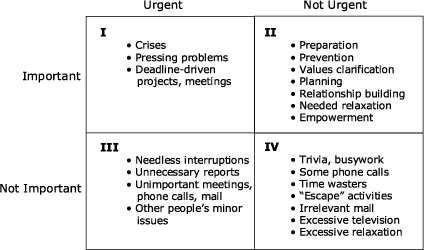
    Secondly, review and prioritize your activities based on your most important goals and activities.  Most of your time should be spent on Quadrant II activities.

    (From the Seven Habits of Highly Effective People by Steven Covey).  Quadrant II activities are Important but Not Urgent.  Because you’ve clearly identified your goals, you can prioritize what’s important and what’s not (hint not everything can be important).  If you’re stuck, pick the top 3 things at any given time and just focus on those.

    Finally, you must track your progress against your goals and periodically assess whether those goals or approaches make sense.  If you’re not making the progress you expect towards your longer term goal, then perhaps you haven’t identified the right activities to get you there.

    Here’s more of a real world example: 

    One of my longer term goals is to get more clients (I’m more specific than that, but for the purposes of this example it doesn’t matter). 

    The primary way for me to find new clients at this time is through personal 1 on 1 meetings with qualified people.  I can’t control the actual client decision, but I can control how many people I actually get in front of in a consultation situation. 

    My experience (and feedback from others) is that a certain percentage of people that I meet with will lead me to a client situation (either directly or indirectly).  I’m still working on the actual percentage, but the conclusion remains the same, I need to meet with a lot of people 1 on 1 in order to reach my goals of getting new clients.

    So every week I’m tracking my personal progress of 1 on 1 meetings with ‘qualified’ people that may be candidates for becoming a client or they work with or know people that may need my services.  In case your curious, my goal is at least 5 1 on 1 meetings a week on top of other networking activities.  It’s challenging to get them set up, but so far I’m doing fairly well.

    As I become more effective at identifying how I can help people and identifying the best candidates for me to help, my success ratio will go up.  It’s not exactly a numbers game, but it does require a lot of persistence.  I’m also identifying other activities that will generate potential clients and at some point I will mix those activities in as well.

    What activities are you doing that aren’t leading towards your goals?  Could you, should you stop doing them now?  Do you track your results on a regular basis?

    I’m interested in your thoughts and would love to hear any stories you have on being busy versus being productive.

    Shawn Kinkade  www.aspirekc.com

    07 Sep

    I had the opportunity to participate in an interesting conversation this afternoon that reinforced some fundamentals of sales that I sometimes forget about.

    The essence of the conversation was why would you need a system for selling.  Admittedly it’s not easy, but isn’t it as simple as contacting a potential customer and asking them if they’d like to buy what you’re selling?

    The problem with that simplification is that you actually are using a system – you’re using the buyer’s system!!!

    You might not have thought about it, but Buyers (even you) have a system for buying and it doesn’t help the seller out one bit.

    Buyers have been conditioned over the last fifty plus years to instinctively distrust salespeople – and generally for good reasons.  It’s unfortunate but true that the stereotype of the salesman is someone using any means possible to trick you into buying something you don’t need.

    Think snake oil sales.

    Think about some time where you went car shopping – especially used cars.

    Or how about this famous movie quote:

    A-B-C. A-Always, B-Be, C-Closing. Always be closing, always be closing.               – Blake

    * One of the few Glengarry Glen Ross quotes I could use here without making this NSFW  ;-)

    Now I’m not saying that all sales people are like this, but there’s a rich enough history that it’s not a surprise that Buyers distrust Sellers.

    Which is why Buyers have a system.  Think about when you go into a retail store and the eager sales person says “What can I help you with today?”   Nine times out of ten, you’re going to say…”I’m just looking – thanks”.

    Whether you really are looking or not.  Why?  Because you’d like to do your shopping on your terms, using your process.

    Later, depending on what it is that you’re buying, you might ask a lot of questions about the product, the price, etc.  It’s highly likely that you will then use this information to comparison shop and as a negotiating point against another seller.  “The guy down the street is selling the same thing for $100 less”.

    Finally, as you start to exit the store without buying - perhaps to see what kind of deal you can get online now that you know all about the product, the knowledgeable but desperate salesperson will try to close you on the product “So can I wrap this up for you?”.

    As the buyer using your system your most likely response is…”I’ll get back to you, I need to think it over”!  Leaving just enough hope that the salesman will chase the opportunity, thinking there’s still a chance.

    The Buyer’s system is a clear cut practiced response to traditional selling techniques refined over time to give the buyer the advantage.

    In the corporate world, the Buyer’s system is even more pronounced.  Most large corporate companies have a whole team of people whose job is to ‘manage’ the purchasing of major items.  They put all sorts of hurdles in place to keep the sellers from doing what they want to do – what they’ve traditionally always done.  This Vendor management group will require a proposal process and will play Sellers off of each other to get the best price – often times at the expense of the financial health of the vendor!

    So what can you do?  You’ve got to sell your product/service to keep the doors open.

    You can start using a non-traditional Sales System. 

    Don’t approach the interaction as a sale, approach it as a consultation.

    As the seller, you need to find out what the buyer needs and determine if you have a product that fits that need.  If not – then you move on with a minimum of wasted time and effort on your part and the buyer’s part.  It’s okay to push for ‘No’.

    If you do have a product that can address the buyer’s need and you have determined that they have money and that they are truly the decision maker, then you can focus on getting them to buy your product.  People like to buy, but they HATE to be sold…so don’t sell them.

    There’s obviously a lot more to this and it’s not easy, but it can be much more effective and satisfying than using the traditional ‘used car’  type of sales approach.

    A couple of suggestion of additional information on this would be to look into Sandler Sales – locally in Kansas City, the guy to talk to (highly recommended) is Dan Stalp.

    You could also check out Spin Selling, a book that’s been around for a while, but is still extremely relevant.

    Do you know of any other non-traditional Sales Systems?What system are you using to sell? 

    Share some stories here.

    Shawn Kinkade  www.aspirekc.com

    05 Sep

    There are a few things that I consistently hold onto as a core part of what I believe and who I am.

    I believe that professionalism is critical to long term success in pretty much anything that you do.

    I believe in science, the scientific process and that the future will be driven in a large part by scientific and technological advancements (good and bad).

    I believe in moderation in all things – including moderation.

    I believe in the hanging curve ball, high fiber, good scotch…wait that’s what Crash Davis believes in…  ;-)

    What I’m not as sure about is the power of positive thinking – not the concept as much as the semi-mystical stuff that seems to go along with it (back to that whole science thing). 

    I don’t buy into most of the explanations / hype around the Law of Attraction and The Secret, that if you wish really hard, then your wish will come true.  It’s a fun thing to talk about but I actually find it a bit disturbing and potentially dangerous or damaging if people are putting too much hope into it.

    Having said all that, I do buy into having a positive approach to life.  Scott Ginsberg had a great post on this today - Corny doesn’t mean ineffective.  Here’s the point that resonated with me:

    Yes, all that positive attitude stuff is TOTALLY corny.
    But that doesn?t mean it doesn?t work.
    I say:
    Believe in whatever makes you more focused.
    Believe in whatever makes you more motivated.
    Believe in whatever makes you more productive.

    Jerry Smith – a Coach here in Kansas City and an overall great guy also has some good posts recently that tie into this topic.  I thought this one was especially appropriate – The luck factor.  His Gary Player Quote summed it up nicely:

    When we get into the negative we tend to filter things accordingly. Use the concept of luck positively – remember what Gary Player the famous golfer says about luck: “The more I practice, the luckier I get”

    All of this reminded me of the famous quote from Henry Ford:

    “Whether you think you can or can’t, you’re probably right.”

    So I don’t buy into the metaphysical powers of positive thinking, but I do absolutely buy into the benefits of a positive outlook.  (I’m not always successful at putting it into play, but I’m fully on board).

    Simply said, if you want to succeed, and don’t we all, then you must have a positive belief that you can succeed.

    Here are some ideas that can help move you to a more positive outlook.

    1. Find and hang out with positive people.  It’s human nature to mirror those people that are around you – make a conscious choice to identify people that are optimistic and can do and then spend time with them.
    2. Stop hanging out with negative people.  I know it’s kind of a repeat of point number 1, but it’s important (probably even more important than finding positive people).  I imagine most people have had the unfortunate experience of working with a ‘Debbie Downer’ type of person – it may be one of the most draining things you can do.  Do whatever you must to get away from those people.
    3. Find the good in things.  This one can be difficult, especially when you’re having a bad day.  I’m not saying be a Pollyanna and ignore the real world, just look for the silver lining (or make one if you have to). 
    4. Make sure you retreat into books, movies – escapes that you really enjoy at least a few times a week.
    5. Adopt a pet – a lot of studies have shown that the unconditional love of a dog or a cat has a host of medical and stress related benefits.  We got our last dog, Pongo from Wayside Waifs which is a really good organization – highly recommended.  I don’t think a fish falls into the same category in terms of inspiration, but I guess you could give it a try…
    6. Laugh – as often as you can…!

    I’m sure there are lot more great ideas on ways to stay positive – feel free to share them here.

    Can you imagine what a more positive outlook would have on your business?  How about your personal life, or the people around you?  How about your kids?

    Have a great day!

    Shawn Kinkade   www.aspirekc.com

    • Page 2 of 2
    • <
    • 1
    • 2